
Landing Page Roasting: The Complete Guide for 2025
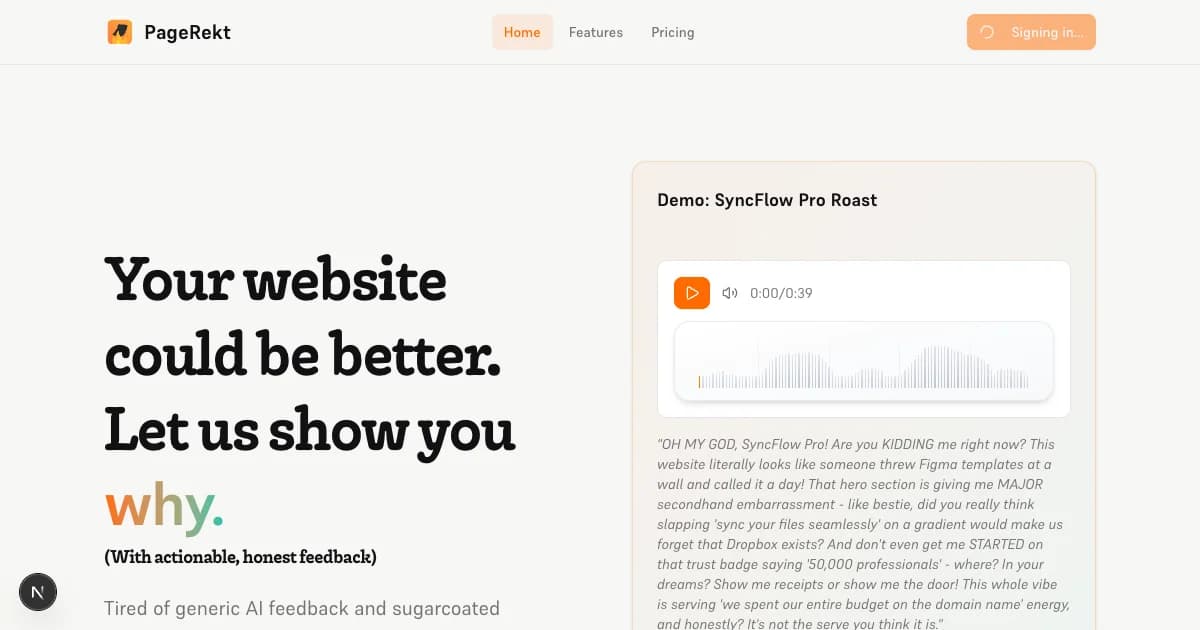
If you've spent hours crafting what you thought was the perfect landing page, only to watch visitors bounce faster than a rubber ball, you're not alone.
The problem? You're too close to your own work to see what's broken.
That's where landing page roasting comes in.
TL;DR: Landing page roasting = brutally honest feedback on what's actually broken (not polite suggestions). Why it works: fresh eyes catch what you miss, cuts through bias, finds revenue-killing issues. Options: AI tools (instant, free-$10), human experts ($50-500, deeper insights), or community feedback (free but noisy). Best approach: AI first to fix obvious issues, then human review for strategy. ROI: Fixing 2-3 critical issues can 2-5x your conversion rate.
What is Landing Page Roasting?
Landing page roasting is the practice of getting brutally honest, no-holds-barred feedback on your landing page.
Unlike traditional usability testing or polite colleague feedback, a good roast cuts through the BS and tells you exactly what's wrong.
Think of it as the difference between your mom saying "it looks nice, dear" and a seasoned marketer saying "your CTA is invisible, your value prop is confusing, and I have no idea what you're selling."
Why Landing Page Roasting Works
Fresh Eyes See What You Can't
When you've been staring at your landing page for weeks, you develop blind spots. You know what every section means because you wrote it.
But your visitors? They have 3 seconds to figure out if they should stay or leave.
A roast provides that crucial outside perspective.
Brutal Honesty Beats Polite Feedback
Your coworkers won't tell you your headline sucks. They'll say "maybe we could test some variations."
A roast? It'll tell you "this headline is vague corporate nonsense that says nothing."
That directness, while sometimes uncomfortable, is exactly what you need to make real improvements.
Actionable Over Abstract
Good roasts don't just say "this doesn't work." They explain WHY it doesn't work and WHAT to do about it.
Instead of "improve your design," you get "your CTA button is the same color as your background - make it orange and put it above the fold."
Types of Landing Page Roasts
Human Expert Roasts
Pros:
- Deep strategic insights
- Industry-specific knowledge
- Nuanced understanding of your market
- Can ask clarifying questions
Cons:
- Expensive ($50-$500+)
- Slow turnaround (24-72 hours)
- Limited to one perspective
- Requires scheduling/coordination
Best for high-stakes pages with significant traffic or revenue at stake.
AI-Powered Roasts
Pros:
- Instant feedback (minutes, not days)
- Affordable or free
- Multiple perspectives (if using persona-based AI)
- Available 24/7
- No judgment about "dumb" questions
Cons:
- May miss industry-specific nuances
- Can't ask follow-up questions (yet)
- Quality depends on the AI system
- May not understand brand context
Best for quick iterations, early-stage validation, or budget-conscious founders.
Community Roasts
Pros:
- Free
- Multiple perspectives
- Real users giving real reactions
- Can go viral and drive traffic
Cons:
- Variable quality
- Can be discouraging if harsh
- May get conflicting advice
- No guarantee of response
Best for building in public, getting diverse opinions, or networking with other founders.
What Gets Evaluated in a Landing Page Roast
A comprehensive roast should cover these key areas:
Value Proposition
Is it immediately clear what you're offering? Does it explain the benefit, not just features? Is it different from competitors? Can a 12-year-old understand it?
Bad example: "Synergistic cloud-based solutions for enterprise workflow optimization"
Good example: "Manage your team's projects in one place. No more email chaos."
Visual Design
Does it look professional and trustworthy? Is the visual hierarchy clear? Do the images support or distract from the message? Is it consistent with your brand?
User Experience
Is the page easy to scan? Is the path to conversion obvious? Are there any friction points? Does it work well on mobile?
Copy & Messaging
Is the tone appropriate for your audience? Is the copy scannable (short paragraphs, bullet points)? Does it focus on benefits over features? Is there social proof (testimonials, stats, logos)?
Conversion Elements
Is the CTA clear and compelling? Is it obvious what happens when you click? Are there trust signals (guarantees, security badges)? Is there a clear path to the next step?
Technical Performance
Does the page load fast (under 3 seconds)? Is it mobile-responsive? Are there any broken links or images? Is it optimized for SEO?
How to Get Your Landing Page Roasted
Use an AI Tool (Like PageRekt)
Enter your URL, choose your perspective (CEO, Designer, UX Expert, etc.), get instant feedback with scores, implement the recommendations, re-roast to see improvement.
Time: 5-10 minutes | Cost: Free to $10
Best for quick iterations and continuous improvement.
Hire a Human Expert
Find a landing page specialist (RoastMyLandingPage, freelancer, agency), submit your page with context about your product, wait 24-72 hours, receive video or written feedback, implement changes.
Time: 2-5 days | Cost: $50-$500+
Best for high-stakes pages or when you need strategic depth.
Get Community Feedback
Post in relevant communities (Reddit r/SaaS, Indie Hackers, Twitter), be specific about what feedback you need, engage with responses, synthesize conflicting advice.
Time: Varies (hours to days) | Cost: Free
Best for validation, diverse perspectives, and networking.
What to Do After Getting Roasted
Don't Take It Personally
They're roasting your landing page, not you. Even harsh feedback is trying to help you succeed.
Prioritize the Feedback
Not all feedback is equally important. Focus on issues multiple people mention, problems that affect conversion directly, and quick wins that have high impact.
Test Before Implementing Everything
Don't change your entire page based on one roast. A/B test major changes to see if they actually improve metrics.
Measure the Results
Track bounce rate, time on page, conversion rate, and click-through rate on CTAs before and after changes.
Iterate and Re-Roast
Landing pages are never "done." Get them roasted regularly (every quarter or after major changes) to keep improving.
Common Landing Page Mistakes
After roasting hundreds of landing pages, these issues come up again and again.
Vague Value Proposition - "We help businesses grow" - HOW? Every business says this. Be specific.
Walls of Text - Your visitors are scanning, not reading. Break up text with short paragraphs (2-3 sentences max), bullet points, subheadings, images, and white space.
Invisible or Confusing CTAs - Your call-to-action button should be above the fold, high contrast color, action-oriented text ("Start Free Trial" not "Submit"), and repeated throughout the page.
No Social Proof - Claims without evidence are just claims. Add customer testimonials, user counts, company logos, case study results, and reviews/ratings.
Mobile Neglect - Over 50% of web traffic is mobile. If your page looks broken on phones, you're losing half your visitors.
Slow Load Times - Every second of delay costs you conversions. Optimize image sizes (use WebP format), remove unnecessary scripts, use a CDN, and minimize CSS/JS.
Too Many Options - Analysis paralysis is real. Don't offer 5 pricing tiers, 3 CTAs, and 10 feature sections. One clear path wins.
No Clear Next Step - After someone clicks your CTA, what happens? Make it explicit: "Start your free trial - no credit card required" or "Download the guide - instant access" or "Book a demo - we'll reach out within 24 hours."
The ROI of Landing Page Roasting
Let's do some quick math:
You have 1,000 monthly visitors and a 2% conversion rate = 20 conversions.
A good roast identifies issues that increase your conversion rate to 4%.
New result: 1,000 visitors × 4% = 40 conversions. That's 20 extra conversions per month = 240 per year.
If your average customer value is $100, that's an extra $24,000 in annual revenue.
Cost of roast: $0-$350. Return: Literally hundreds of times your investment.
Even a 0.5% improvement in conversion rate pays for itself in days.
When to Roast Your Landing Page
Before Launch - Get feedback while you can still make changes easily. Better to hear "your value prop is confusing" before you've spent $10K on ads.
After Launch (But Before Scaling) - You've got real data now. A roast can explain WHY your metrics are what they are.
When Conversion Rates Drop - Something changed. A roast can identify if it's your page or external factors.
After Major Updates - Redesigned your page? Get it roasted before pushing to production.
Quarterly - Make roasting part of your optimization routine. Fresh eyes every 3 months catch issues you've adapted to.
Get Comfortable with Uncomfortable Feedback
Landing page roasting works because it's uncomfortable. It forces you to see your page through a stranger's eyes. It highlights problems you've been ignoring.
But that discomfort is where growth happens.
Your landing page is often your first impression, your sales pitch, and your conversion engine all in one. Getting it roasted isn't admitting defeat - it's acknowledging that even the best landing pages can be better.
So go ahead. Get roasted. Take the feedback. Make the changes. Watch your conversion rate climb.
Your future customers (and your bank account) will thank you.
Enjoyed this article? Share it!